
Are you an outstanding investor wanting to expand your business, or a beginner wanting to get started in the world of trading? For both cases, opening an LLC can be one of the best solutions for the business structure of your business.
This is because an LLC in the United States can give you numerous advantages for your trading company, such as access to a multitude of brokers and types of investments (ETFs, options, futures...), limited liability, anonymity, and much more.
In this article, we will delve into those advantages that the LLC can contribute to you, and we will guide you on how to open this type of company to start enjoying its characteristics. Let's get started!
What is an LLC?
A limited liability company (LLC) is a very popular American business structure, whose main features are:
- Limited liability: the owners are not personally liable for the company's debts, thus protecting their personal assets from being used to cover the company's debts. LLC.
- Tax Transparency: The profits and losses of the LLC are “passed through” directly to the owners, who report this income on their personal tax returns.
Other features that make LLCs very popular are their low start-up costs and maintenance, an unregulated distribution of profits, the privacy they provide, and a Flexible and simple management. Let's see below how all this applies to trading and investments.
Advantages of the LLC for trading and investments
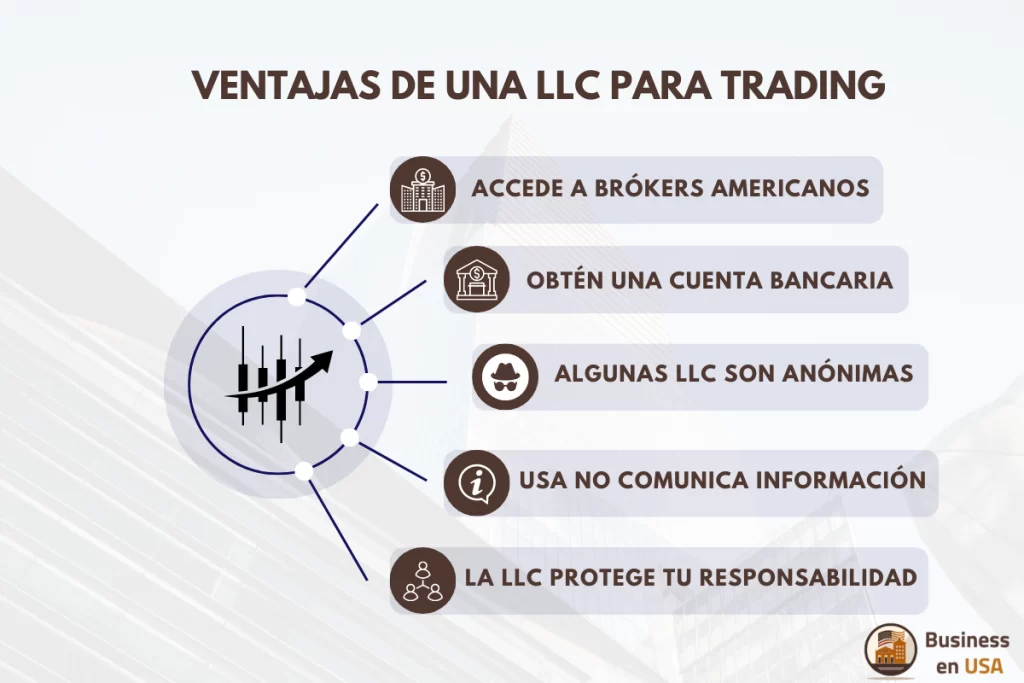
Buying and selling financial assets in the short term to make a profit on the price difference or acquiring assets to wait for them to appreciate over time can be more effective by creating an LLC.
Access American brokers
By having an LLC for trading and investments, you will be able to access the best brokers (stockbrokers) in the world, which, logically, are from the United States.
Although you can operate in the financial markets through these intermediaries without the need to have an LLC, in some specific cases the clients must be US citizens or companies.
Although there are dozens of brokers that serve to trade and invest in the United States (and in the rest of the world), when choosing one you have to verify that it is supported by the main regulatory bodies in the nation:
- Commodities Futures Trading Commission (CFTC).
- Securities and Exchange Commission (SEC).
- Financial Conduct Authority (FCA).
Get an American bank account to facilitate deposits
In order to buy, sell and hold financial assets and collect income and dividends, you must first make an initial money deposit and link a bank account.
And for this, obviously, you will have to have one opened in a US bank. As with many brokers, banking entities facilitate opening for local users, whether physical or institutional, andan LLC gives you this quality.
By owning a limited liability company, you will be able to navigate the United States banking and financial system without any complications, enjoying efficient and fast processes linked to money.
Some LLCs are anonymous
To carry out trading or investments, you must necessarily verify your identity through some type of document, which can violate privacy.
However, an LLC can be completely anonymous, since it has the ability not to disseminate the name of its partners in the state database.
Although not all states allow you to register an anonymous limited liability company, Delaware, Nevada, New Mexico and Wyoming yes they do.
In principle, to enjoy this benefit, you just have to avoid providing your name in the registration process. And that's it, you can trade on the stock market anonymously.
USA does not communicate information about company bank accounts through the CRS
On the other hand, LLCs benefit from an international agreement called the Common Reporting Standard (CRS) that allows countries to receive annual information on the bank accounts of their citizens abroad.
This information ranges from balances and interest to dividends and profits from sales of stock assets. In any case, the United States is a party to the treaty, but does not share information except in judicial situations.
In any case, commercial accounts, such as those created through an LLC, are not affected, as they are protected by US bank secrecy, ensuring that the data remains within the country.
The LLC protects your personal liability
As its name indicates, the "limited liability" of an LLC exercises the function of restricting the liability of its members, since the company is established as an autonomous legal entity.
In essence, this implies that the personal resources of the members of the company are protected and cannot be used to settle debts and commitments that the LLC may acquire.
In other words, it is about a very important safeguard, since the potential loss of a member is limited only to the capital that he contributed to the business.
The separation of assets and liabilities between the commercial entity and its owners is fundamental in terms of financial security because it guarantees that the financial obligations of the company cannot erode the personal assets of the members, ideal for trading and investments where leverage exists.
LLCs and taxation related to trading
When setting up an LLC for trading and investments in the United States, it is very important to take into account some tax issues linked to these two disciplines.

LLCs are pass-through entities
First of all, you have to understand that limited liability companies are pass-through entities, also called "pass thorugh" or "fiscally transparent" organizations.
What does this mean? This means that LLC taxes are transferred to the legal entity of its members, without having to pay corporate taxes.
Does your LLC qualify as ETBUS?
The term ETBUS means "engaged in trade or business in the United States" and refers to a company that must pay taxes to the US treasury for:
- Providing services within the country.
- Having an establishment permanent within the country.
- Receive fixed, determinable, annual or periodic income (FDAP).
If you open an LLC for trading and investments, the company will not have a physical presence or employees in charge or linked local partners, so it would not count as ETBUS due to the first two requirements.
However, there may be the possibility that you pay taxes for receiving income from your investments. But you can avoid it, as we will tell you below.
Be careful with dividend taxes
The taxation of your LLC for trading and investments depends on different types of earnings: capital, interest and dividends. The first two do not generate taxes, while dividends are subject to a 30% withholding for Income Tax.
If you are an owner and reside in a country with a tax agreement with the United States, you can reduce that withholding. However, this classifies your company as ETBUS and requires an individual Tax Return with the IRS because dividends are FDAP income.
However, you can legally avoid these taxes if you sell shares before receiving dividends by paying attention to announcements at the shareholders meetings of the companies in which you invested.
How to open your LLC and start trading?
To open your LLC and start trading and making investments, you just have to follow a simple seven-step process:
Step 1: submit the incorporation documents
Start the process by submitting the necessary documents to legally establish your LLC in your state, complying with all legal requirements. Be sure to pay the appropriate filing fee.
Step 2: Get your EIN
Get your Employer Identification Number (EIN) from the IRS. You can usually get it online in a few clicks.
Step 3: Create an operating agreement
Establish an operating agreement that defines the operations and functions of the LLC. It includes clauses that allow the purchase and sale of shares and other financial assets. This agreement is fundamental to establish the legal and operational bases.
Step 4: designate an authorized person
If your LLC has more than one owner, select the person authorized to make asset purchases. Defines a clear procedure to carry out these transactions.
Step 5: Research your investments
Conduct exhaustive research on the possible investments you want to make. Conduct online searches and evaluate the options available to ensure they align with your LLC's investment strategy.
Step 6: Open an account at a broker
Choose a trustworthy stockbroker or broker and open a trading account in the name of your LLC. Remember to comply with all requirements and provide the necessary documentation.
Step 7: fund your account
Finally, once the account is open, make the necessary deposits to finance it and be ready to operate.
As you can see, for trading and investments, opening an LLC in the United States is a very good option due to the multiple advantages it offers.
In just seven steps, you can already be buying and selling financial assets to grow economically over time.
Get professional help to open your LLC
- Business experts in the USA
- Legal and accounting team
- Free first consultation


Written by
Ignacio Navarro
Ignacio Navarro is a Certified Public Accountant, graduated in 2020 from the National University of Tucumán. Founder of Start Companies since 2023, he advises clients worldwide on forming LLCs in the United States and on proper tax filing. His expertise combines legal, tax, and practical knowledge, offering a comprehensive service that spans from company formation to bank account setup and sales platform integration.